Growing up, I remember hearing my grandmother talk about her Bunco parties.
She’d have all the best stories about the people at her table, the desserts they served, and sometimes even about the cash she won. It sounded like an excellent time.
Naturally, I wanted to go. But apparently Bunco had an age requirement… and I was repeatedly informed that I was not old enough to attend.
Fast forward a few decades and I am now, somewhat alarmingly, the kind of adult who qualifies for Bunco night.
I have adult money. No one is stopping me. So when I saw my church hosting a Bunco party, I did what any curious person would do. I bought a three tickets, brought my husband and mother (incase I needed an older lady to vouch for me. I didn’t) and went undercover to experience an authentic church-lady Bunco night and finally discover what all the fuss was about.
Within about five minutes of walking in, the mystery started to make sense.
The tables were full of food, the drinks were flowing, and the room was buzzing with people ready to throw some dice and have a good time.
Everyone promised me the same thing: “You’ll pick it up quickly.”
And they were right.
Bunco is one of those games that sounds confusing when you first hear about it but becomes obvious once the dice start rolling.
What Is Bunco?
At its heart, Bunco is a fast-paced dice game mixed with a little bit of friendly competition and a lot of socializing.
Players rotate around tables, working with different partners each round, trying to score points by rolling a specific number on three dice. It’s simple, lively, and built for conversation and laughter along the way.
In many ways, Bunco feels like speed socializing with dice.
What You Need to Play Bunco
To play Bunco you’ll need:
- 12 players (though the game can be adjusted for other numbers)
- 3 dice per table
- 3 tables of four players each
- A bell (for the head table)
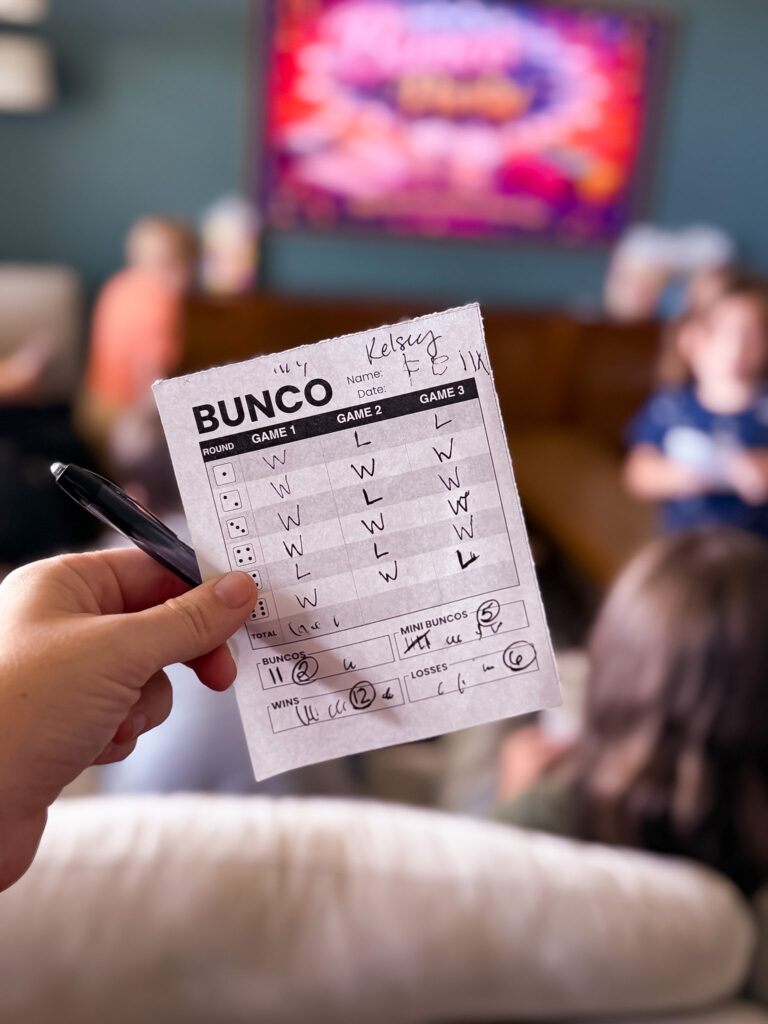
- Score sheets with a place to track Buncos, mini Buncos, and wins We created a downloadable Bunco Party Kit with everything you need!
- Pencils
- Table Numbers
- Name tags
Most Bunco nights also involve food, dessert, and a few prizes at the end, but those are technically optional… though highly recommended.
How the Tables Work
Players sit at three tables of four people each.
One table is designated as the head table, and that table controls the game. When the players there ring the bell, the round begins or ends.
Each player sits across from a partner, and together you’ll work to score as many points as possible during the round. One player each round is designated the scorekeeper and will keep track of the scores on a scrap piece of paper.
How the Rounds Work
There are six rounds in a Bunco game, one for each number on the die.
Each round focuses on a different number:
- Round 1 → you want to roll 1s
- Round 2 → you want to roll 2s
- Round 3 → you want to roll 3s
- and so on up to Round 6
When it’s your turn, you roll all three dice.
- Each die that matches the round number earns 1 point
- If you score at least one point, you roll again
- If you score zero points, the dice pass to the next player
This keeps the game moving quickly and gives everyone lots of turns.
What Is a Bunco?
The most exciting roll in the game is, unsurprisingly, the Bunco.
A Bunco happens when you roll three of the round’s target number. For example: Rolling three 4s during Round 4. When this happens you score 21 points and are expected (by tradition) to celebrate with a little whoop!
What Is a Mini Bunco?
A mini Bunco happens when you roll three of the same number that is not the round number. For example: Rolling three 5s during Round 2. A mini Bunco earns 5 points, which is still worth celebrating.
Players typically track how many Buncos and mini Buncos they roll because these often earn prizes later.
How Rounds End
The round continues until one team at the head table reaches 21 points.
When that happens, they ring the bell and all tables stop playing immediately. (If you’re in the middle of a turn finish out your turn, but stop once you do not score.)
Each team compares scores.
The team with the higher score moves to the next table.
The team with the lower score stays put
On your score sheet you can either mark your score in the box or just write W for win and L for loss for that round. We did the latter.
When teams move to the next table, players also switch seats so they end up with new partners each round.
The only exception is the head table. If a team wins there, they get to stay — and attempt to defend their spot with the same partner.
How the Game Ends
After six rounds, the Bunco game is finished. A Bunco night consists of 4 full games of Bunco played. So after the first full game of six rounds, you’ll begin the second game. After the fourth game, the night is over.
Most Bunco nights then award prizes for things like:
- Most Buncos
- Most mini Buncos
- Most wins
- Most losses
Sometimes prizes are small gifts. Sometimes they’re a little cash. Sometimes they’re just bragging rights. You can choose what works best for your group. This is also why there’s usually a small amount each player adds to the pot when attending Bunco night. $5 -$10 is typical. This cash is then used to give to winners.
Example: $5 Bunco fee from 12 players = $60.
- Most Wins: $20
- Most Buncos: $20
- Most Mini Buncos: $10
- Equal Wins/Losses: $5
- Most Losses: $5
You can also have the fee go directly to the host to help offset the cost of providing food & beverages.
At our church Bunco night they entered all of our names into a bowl and drew them out for us to come pick out prizes in addition to the cash rewards won by players. Many have shared that their Bunco parties do this as well and the host uses the Bunco fee to purchase the gifts or everyone brings something for the night based on a low set price range.
I would recommend keeping this very easy an minimal if not eliminating it entirely. Deck of cards + some candy feels like the appropriate small, thoughtful gift you don’t have to stress over. (No one wants the stress of a Christmas gift exchange each month!)
Why People Love Bunco
What surprised me most about Bunco wasn’t the dice rolling — it was the atmosphere.
Because the rounds are short and players constantly rotate tables, you end up chatting and laughing with people you may not have met before.
Every round feels like its own micro game.
You share quick competition, a few inside jokes, and then move on to another table to start again. You meet up with players again and again as the games go on which just adds to the fun.
By the end of the night, the room feels less like a group of strangers and more like a party. And honestly? I completely understand why my grandmother loved it so much. Because Bunco isn’t just a game. It’s an excuse to gather, laugh loudly, eat some good food, and maybe — just maybe — win a little cash to fund your next Bunco night!
If you enjoyed this post on How to Play Bunco (And Why Everyone Seems to Love It) then you may also enjoy:
How to Host A Bunco Party (Everything You Actually Need)
Quick Games for Busy Families
How to Play Dice Bingo
Speed Limit 99: A Simple Mathy Card Game