If you’ve ever been to a Bunco party you already know what the hype is about. If you haven’t, I want to help you because this is one of the easiest, most fun parties you can throw and we’re going to walk you through exactly how to pull it off.
What Is Bunco (The Quick Version)
Bunco is a dice game that you might have heard your grandmother talk about playing with her friends or from neighborhood ladies who meet to play every month. It’s an easy game perfect for all ages. If you want the full rundown on how to play, we’ve got a complete breakdown.
Read: How to Play Bunco (And why everyone seems to love it)
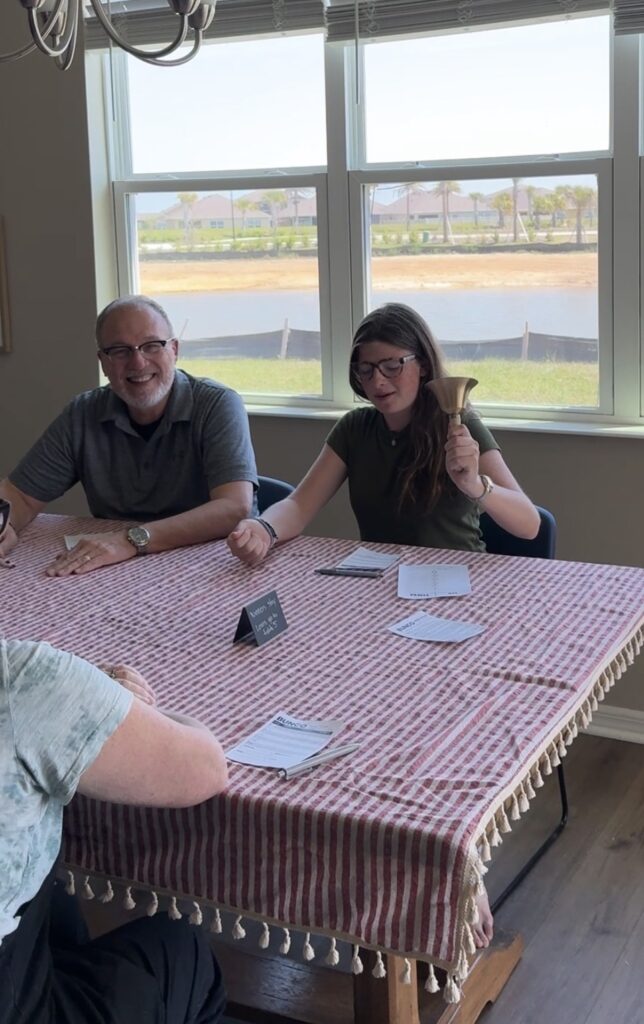
The short version: A large group of players play a series of games, each consisting of six rounds. Each round you’ll throw three dice trying to roll the number of the current round. Every time you do, you score a point. When you win you advance to the next table on your journey to the Head Table. Here is where the games are controlled. When a team at the head table reaches 21 points, they ring the bell to stop all the games and players rotate tables based on the current score.
After all games are played (usually 3-4 games total) cash prizes are awarded to players in various categories.

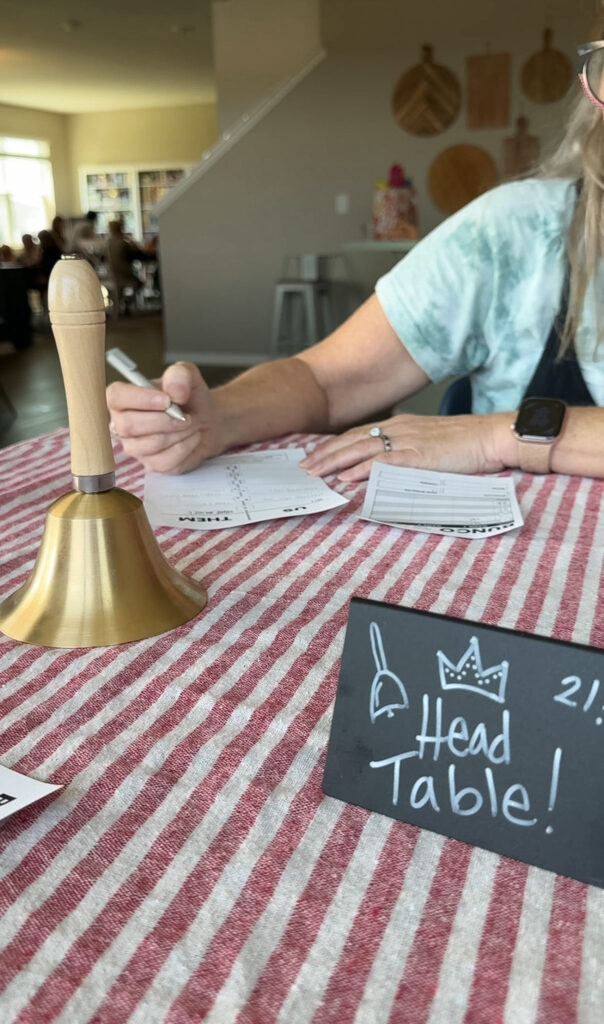
Large Dice | Hand Bell | Chalkboard Tents | Tablecloth
How Many People Do You Need to Play Bunco?
Bunco works best in multiples of four since you play in teams of two at tables of four.
The most common setups are 12, 16, or 20 players for home games, but you can play with as many people as you have tables and chairs for. (Our church hosted over 40 players!)
Your space, your seating, and how you like to plan will determine your number. Some people like the simplicity of just inviting 12 players to form their “Bunco Group.” Others invite more and see who comes. Either way, you’ll want to decide how many to invite before you set up and form your guest list around that.
What If You’re One Player Short — The Ghost Player
If you end up with an uneven number, don’t panic. You just need a ghost player.
Make a simple ghost marker (our Bunco Party Kit has a ghost player you can print out) and set it at the open seat. The ghost moves through the game like any other player. Whoever is partnered with the ghost rolls for the ghost on their turn. When it’s time to rotate, the ghost’s partner is responsible for moving them to the next table. (More on that below.)
It sounds more complicated than it is. After one round everyone gets it.
What You Actually Need to Host Bunco
- Tables and Chairs: One table per four players. Card tables are perfect. This set comes with a table and four chairs!
- Dice: Three dice per table. I use this bulk set! (it’s versatile for a wide variety of games)
- A Bell: The head table needs a bell to start and stop each round. Go for novelty with a large bell (I have this one!) or the simplicity of a counter bell works just as well.
- Table markers — You’ll want some way to number each table so players know where to move next. Table Numbers – Chalkboard Tents – our Bunco Party Kit has paper tents that work great!
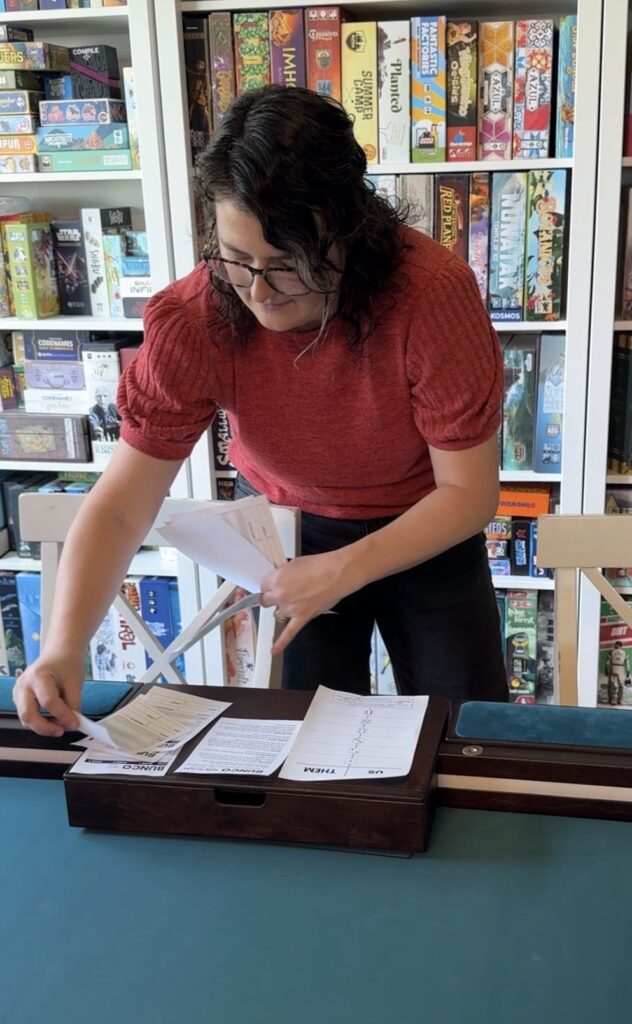
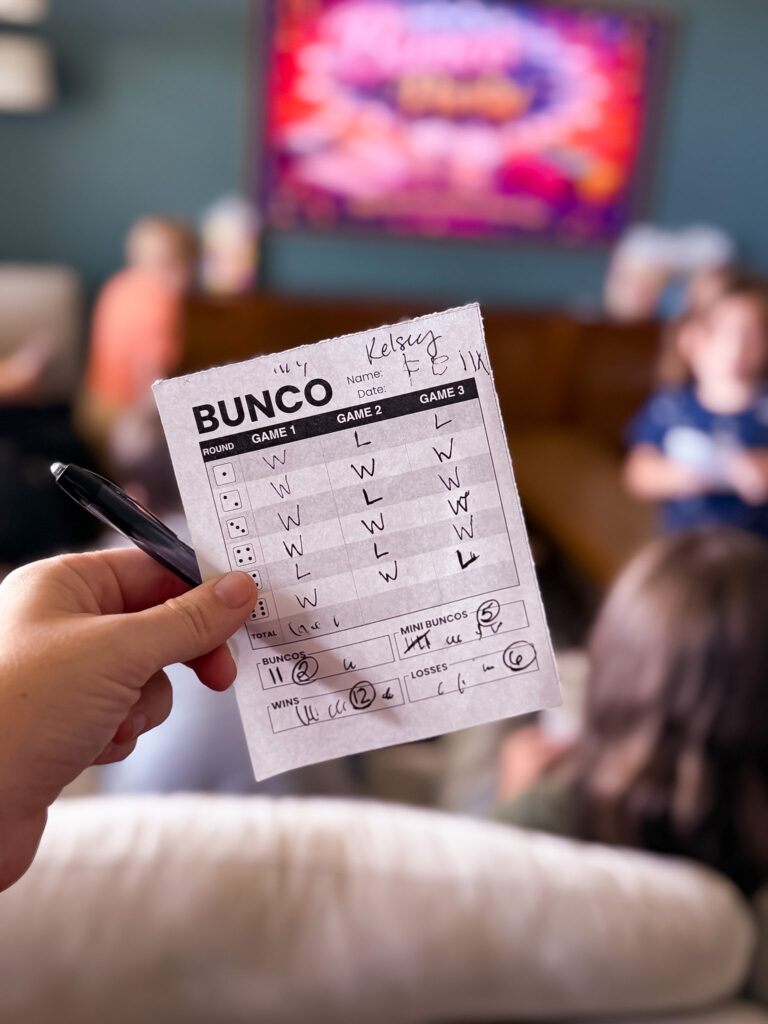
- Score Sheets Every player needs a score sheet. We made our own and included them in our Bunco Party Kit if you want to skip making your own.
- Food and Drinks Bunco is as much about the snacks as it is the game. Keep it simple with finger foods, chips and dip, a drink station (I love this dispenser,) and something for dessert. If you’re playing multiple games, save dessert for the break between games. Trust us on this one.
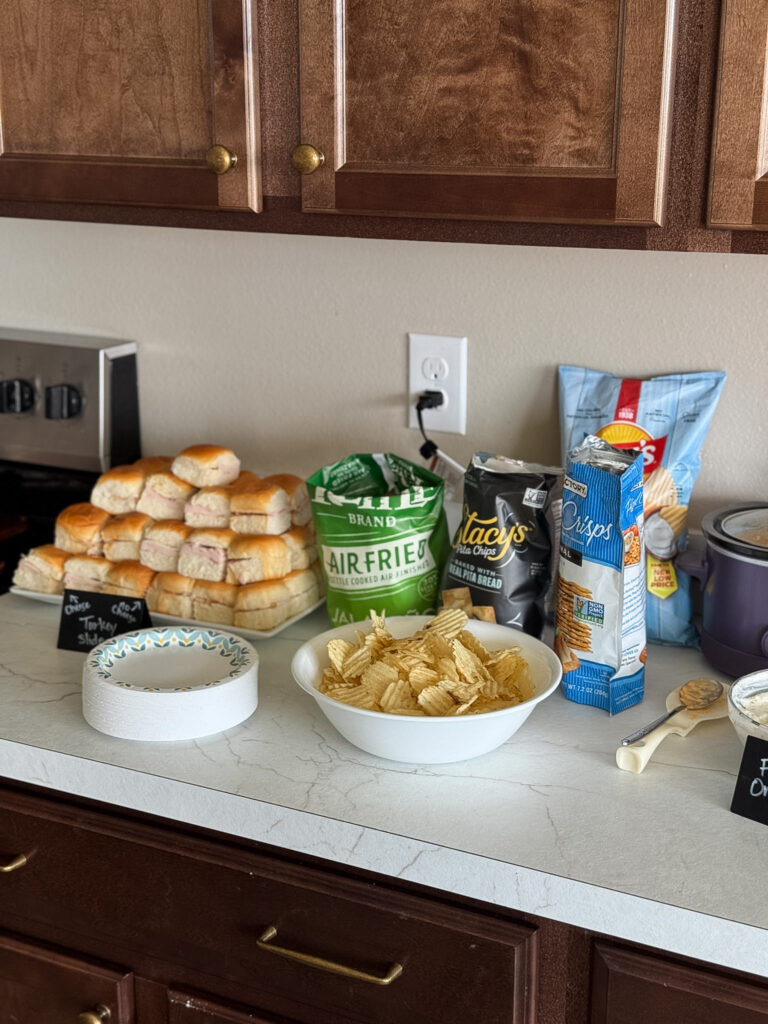
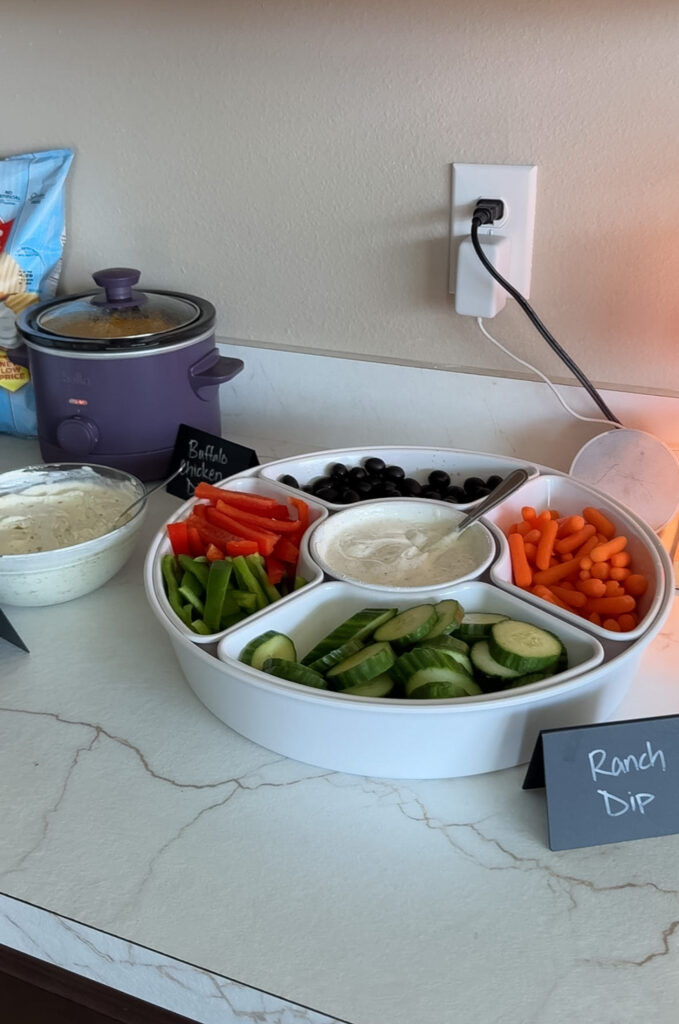
Serving bowls | Mini Crock Pot | 5 Section Serving Platter
How to Run the Party
Set your tables and number them before guests arrive. Assign starting seats and make sure every table has three dice and score sheets ready to go.
When everyone is there, take a few minutes to explain the rules. It genuinely only takes a few minutes and even first timers will feel comfortable by the end of the first round. The head table rings the bell to start and from there the game runs itself.
A simple structure that works really well: Food and mingling while guests arrive, rules explanation, two games, a dessert break, one more game. That’s a complete Bunco party and will take you about 3 hours to run through the circuit.
How to Rotate Tables
The table swap at the end of the rounds sometimes trips people up, but it’s truly very simple.
At the end of each round, players will look at the score. The winning team will get up and advance to the next table. The losing team will stay at the table but one player will switch seats so that they are not partnered together for the next round.
Example:
Table 3 has Players A + B (partners) and C + D (partners)
Table 2 has Players E + F (partners) and G + H (partners)
A + B score the most points and win, they’ll advance to Table 2
Players C + D stay at the table, but player C switches to the seat formerly occupied by player B. Now they will not be partners with D for the next round.
When A + B arrive at Table 2, they sit down with Players E + F with whom they are now partnered with respectively (A+ E and B + F. The exact pairing doesn’t matter, A+B and E+F just won’t be partners anymore)
This is how all tables rotate EXCEPT the Head Table.
This table is where everyone is trying to go. When you get to the Head Table, you stay with the partner you arrived with. So in this example, G+H win at table 2 and advance to the Head Table to face off against the partner players there.
The winners at the Head Table stay until they lose and do not switch partners. (Think of it like defending your title)
The losers at the Head Table go back to the bottom table where they will be split up and get new partners.
In a 12 player game you’ll have 3 tables and players will advance from table 3 to 2 to the Head Table (table 1) and then back to 3 after a loss at the Head Table.
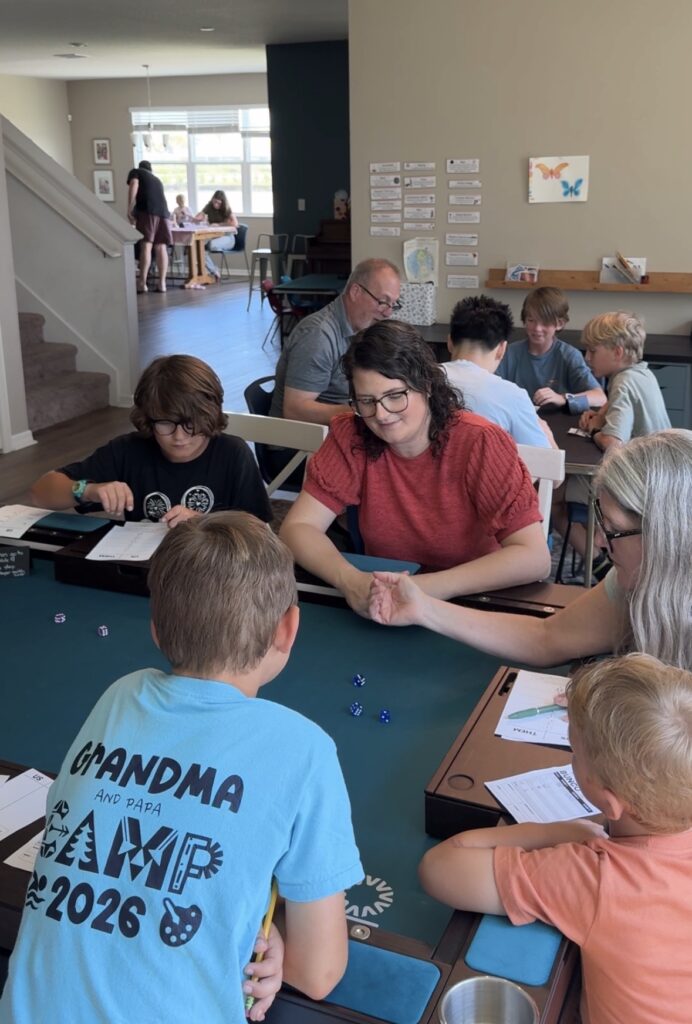
Bunco Prizes
Prizes are a Bunco tradition and part of what makes everyone play just seriously enough to care.
The most common setup is a cash buy-in at the door (typically $5 to $10 per player) which gets pooled and split into prizes at the end. With 12 players at a $5 buy-in you’re working with $60. With 20 players at $10 you’ve got a real prize pool. A 30/25/20/15/10 percentage split across categories is a common approach, or you can set flat amounts based on your pool.
Typical prize categories and suggested amounts:
- Most Wins: $15–$30
- Most Buncos: $10–$25
- Most Losses: $5–$8 (yes, losing pays! Keeps everyone invested)
- Most Mini Buncos: a small prize, similar to Most Losses
One fun optional category worth knowing about is the Traveling Bunco prize. A Bunco marker gets passed around the room. Any time someone rolls a Bunco they call it out and claim the marker. Whoever is holding it at the very end of the last game wins a prize, typically $10–$12. We didn’t use this one at our party but it’s a great addition that keeps the energy up throughout.
There are endless ways to customize your prize structure. These are just the most common starting points.
A note on gifts: Some parties have a gift for every player where everyone brings a $10 gift and names are drawn out of a hat raffle style. It can feel a little like a white elephant situation which isn’t for everyone. Our take: keep it to cash prizes for the traditional winner categories and call it a day. Simple is better.
If you’re hosting for a special occasion like we did for our daughter’s Bunco Birthday party, small gifts for each family to add to the prize pool are a thoughtful touch. We kept it simple and on theme: small games, decks of cards, dice. Nothing over the top. But this is entirely optional and nobody expects party favors. The game is fun enough on its own.
Why Bunco Works for Any Group
Here’s what makes Bunco different from almost every other party game. The rotating tables do the socializing for you. By the time you’re a few games in, every guest has sat across from almost every other guest. People who didn’t know each other walking in are comfortable and laughing together before dessert even comes out. In many ways, it works better than the vast majority of party games we’ve played over the years with big groups, (and if you need recs on those, we’ve got ‘em!)
Bunco works for all ages (our youngest player was 5,) groups that don’t know each other, and most importantly works when half the room has never played before. And as the host, once the game starts you get to set down the hosting hat and just play like everyone else.
That almost never happens at your own party.
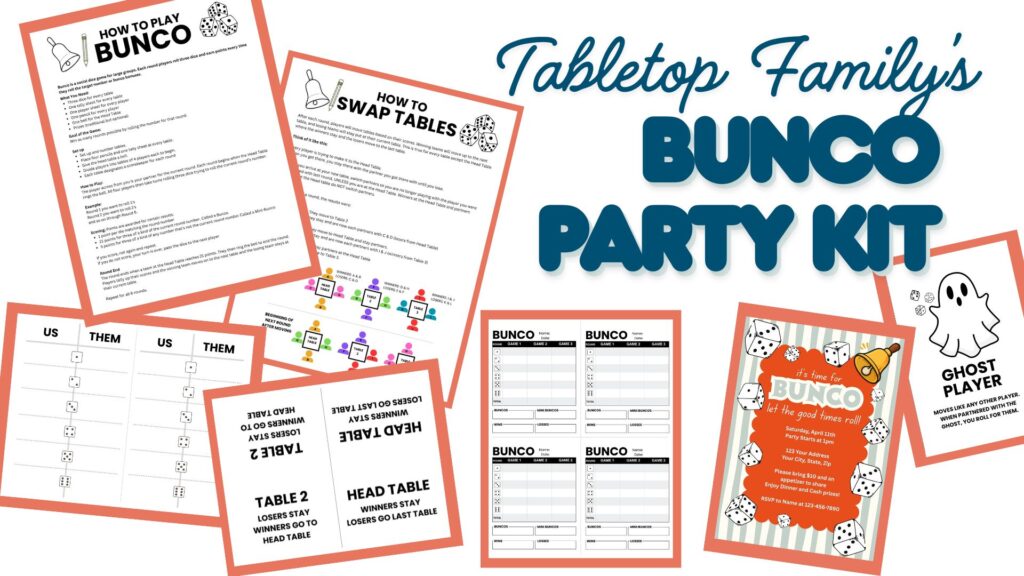
Grab our Bunco Party Kit!
We put together everything you need to run your own Bunco party!
Our Bunco Party Kit Includes:
- Full rules sheet to help you learn and explain the game
- A guide for swapping tables with a diagram breaking it all down
- A ghost player marker with rules for how to play with a ghost player
- A quick rules guide you can place on every table to help your guests
- Three tally sheet designs to keep score
- Two bunco score cards with four and three game series options.
- Printable table markers you can use to mark each table at your party.
- Editable party invitation template
Grab the Bunco Party Kit!
If You Enjoyed This Post on How to Host a Bunco Party (Everything You Actually Need) Then You May Also Enjoy:
How to Play Bunco (And Why Everyone Seems to Love it)
Party Games for Large Groups
Games to Play While Watching Football (Free Printables)