If you’ve ever found yourself waiting at a restaurant, stuck in a doctor’s office, or trying to keep kids entertained during quiet time—this list is for you. These easy pen and paper games are fun, fast to learn, and require nothing more than a pencil and a scrap of paper. That’s it!
From strategic showdowns to silly scribble fests, these games are perfect for kids, teens, and grown-ups alike. Whether you’re looking for a quick screen-free activity, a backup plan for long waits, or a go-to boredom buster for your bag or glovebox, these pencil-and-paper classics have you covered.
We’ve tested every game on this list with our own family (seven kids = plenty of chances!), and we’re rounding them up here in one place so you can find your favorites fast.
This is an on going series! We’re always sharing new games on Instagram and YouTube, so bookmark this page to your favorites and reference whenever you need a quick game to play!
Need some supplies? Here are the notebooks I love keeping in my purse and car to play these games and my favorite pens and highlighters to use when playing! If you want to learn the math behind many of these games and learn even more fun paper and pencil games check out the book Math Games with Bad Drawings. We’ve learned many of the below games from this book and highly recommend it!
Lasso
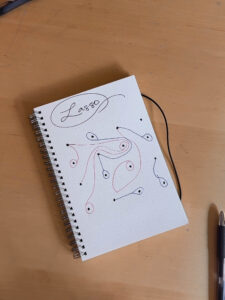
Draw a grid of dots — 4×4, 5×5, and 6×6 work great but any size will do! Taking turns, you’ll start at one dot, and draw a line to another dot and lasso it. (circle it.) You may not draw a line that leaves the boundaries of the grid and you cannot intersect lines. Dots can have a lasso start from them a maximum of two times. You may only lasso an unused dot. When there are no more legal moves remaining, the player who drew the last lasso wins the game.
Full blog for how to play
Watch on Instagram.
Ultimate Tic Tac Toe
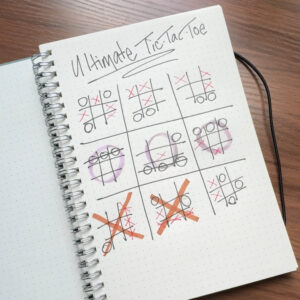
Tic Tac Toe but with a twist! Draw 9 tic-tac-toe boards. You are still playing as Xs and Os, but now, each move determines which tic-tac-toe board your opponent must play in next. It’s like playing nine mini-games at once! When you win a tic-tac-toe game, mark a large X or O through the game to signify you’ve won. Keep playing until someone has won three mini games in a row to win Ultimate tic-tac-toe.
Full blog for how to play
Watch on Instagram.
SIM
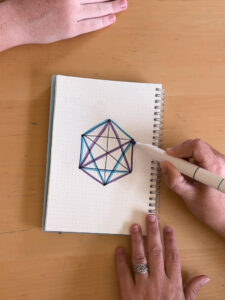
A sneaky math game perfect that makes the perfect boredom buster! Two players will go head to head to try and AVOID drawing a triangle in their color. The first player to do so, loses.
Draw six dots to form a hexagon on a piece of paper. (If it is easier, you can draw all of the connecting lines between each dot, but you do not have to.) Each player needs a pen, marker, or highlighter in their own color. Take turns drawing lines between two unconnected dots. The first player who forms a triangle in their color with each of the three sides connecting to dots on the hexagon’s outer points loses.
Full blog for how to play.
Watch on Instagram.
NIM
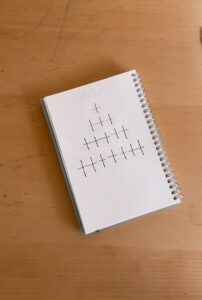
An easy math game to play that’s simple to learn and highly strategic! Your goal is to avoid crossing off the last line. Start by drawing 3-5 rows (or more if you wish!) of lines or dots with each row a different length. Players take turns crossing off as many as they want from a single row. You must cross off at least one, but you can do more up to and including the entire row, but only from a single row per turn. The player forced to cross off the final line loses.
Did you know, you can play this with any pop-it fidget toys your kids might have? Give it a try!
Watch How to Play on Instagram
Bridges
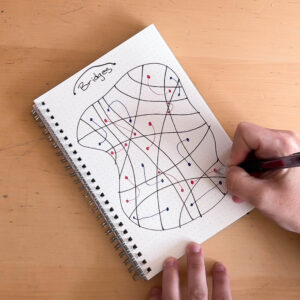
Draw any large shape on paper and divide it into 40–50 sections. Taking turns, players draw a “bridge” by marking a dot in one section, drawing a line through a second, and ending with a dot in a third. Sections can only be used once — no starting, crossing, or ending in a previously used section. You also can’t cross more than one section per bridge. The last player able to draw a valid bridge wins!
Watch How to Play on Instagram.
Order and Chaos
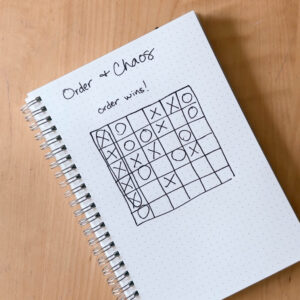
Draw a 6×6 grid. Select one player to be order, the other to be chaos. Players will alternate turns, each drawing either an X or an O on the grid. Neither symbol, Xs or Os, belongs to either player, rather both players can choose to write either symbol on their turn. The player who is Order is attempting to get 5 in a row of the same symbol, either orthogonally or diagonally. If Order is successful, they win. The player who is Chaos is trying to prevent them from doing this. If Chaos is successful, they win.
Watch how to play on Instagram
Dandelion
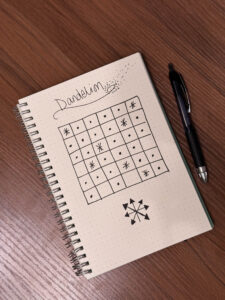
Draw a 6×6 grid and an 8 pointed directional star. Select one player to be the Dandelion and the other to be the Wind. The Dandelion wins if they successfully fill each space of the grid with either a Dandelion or a seed. The Wind wins if they have at least one open space on the grid after the final round. Each round, the Dandelion will draw a dandelion (represented by an asterisk or you can get creative,) on one of the open spaces in the grid. The Wind then chooses one of the 8 directions (N, S, E, W, NE, NW, SE, SW) on the directional star, draws an arrow head to indicate the one they chose, and then from the dandelions on the grid, draws a seed (just use a simple dot or circle) in every open grid space from every dandelion (not just the most recently drawn dandelion,) in the direction they chose. Repeat this for a total of 7 rounds, meaning that there will be one direction space the Wind does not choose. If there is an open spot on the grid at the end of the 7th round, the Wind wins. If at any point in the game the Dandelion covers every space, the Dandelion wins.
Watch how to play on Instagram.
S.O.S.
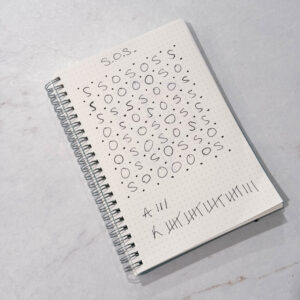
Draw a grid on your paper. You can set this grid however large or small you’d like; a 7×7 is a good starting point for a standard game. Players are trying to earn the most points by making SOS on the grid either orthogonally or diagonally. Each turn, players will write either an S or an O on a space in the grid. You can use either letter. If you do not create an SOS, your turn is over. If you do create an SOS, mark a point by your name, then take another turn. If you make another SOS, you get another point and another turn, and so on and so forth until you do not create an SOS when your write a letter on a space in the grid and your turn ends. Play until the entire grid is filled. The player with the most points wins the game.
Hold the Line

Create a 4×4 grid of dots. Playing in turns, players will draw an orthogonal or diagonal section of line connecting dot points. The line can extendd from either end of the line once started, there is no requirement to continue where your opponent left off. You can draw the line however long you wish, connecting multiple dots, so long as it continues in a straight line and does not change directions once you start drawing. The line may not intersect itself or end on a dot that is already used. The player who draws the last legal section of the line loses.
Black Hole

Create a six level pyramid of circles, each player alternates turns writing the numbers 1-10 one at a time each into individual circles on the pyramid in their own color. Once both players have drawn their 10th number, there will be one circle left, this circle becomes the black hole. Players calculate the sum of their circles adjacent to the black hole. The player with the lowest score wins. If playing with three players, draw a seventh level on the pyramid and only have players write the numbers 1-9.
Bunch of Grapes
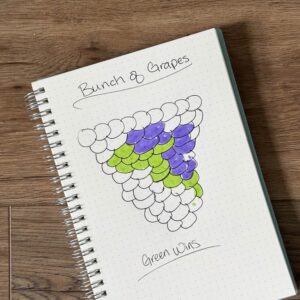
Create a drawing of a bunch of grapes by drawing a series of connected circles. The circles should be random and different from game to game. Each player needs a pen or marker in their own color. The first player places a dot on any of the grapes, followed by the second player who does the same. The second player to select their grape will begin the game by placing a dot in any one grape that is connected to the grape with their current dot. They will then fill in their previous grape. Players will alternate doing this until one player runs out of grapes to move to and loses the game.
Splatter

Splatter is a fun game for two players where your goal is to be the last player left with a dot on the grid. To play, draw a grid with an even number of squares on your paper. Using two different colors, place an even number of dots for each color in the grid squares. One dot in each square. You can have players select their color and take turns adding a dot onto the grid or, to save time, you can have one player place all of the dots randomly on the grid and the other player select the color they’d like to play with.
On their turn, players will select one of their dots to fill in. You can fill in a single dot, or you can choose to splatter the dot and color in all of the squares around it. Players must take their turn, you cannot skip your turn. The last player left standing is the winner.
Row Call
Row Call is a clever twist on Tic Tac Toe where your opponent controls your fate. To play, draw a 4×4 grid and choose a symbol for each player. On your turn, pick a row or column where you’d like to place your symbol—but your opponent gets to decide exactly which open space it goes in. Then they take their turn, choosing a row or column while you decide where their symbol lands. Players alternate turns this way until someone gets three of their symbols in a row, either horizontally or vertically, to win the game.
Knight Chase
2 Players
Create an 8×8 grid. Each player places a dot representing their horse in opposite corners of the grid. Players will alternate turns moving their horse. Movement is the same as a knight on a chess board (two squares in on direction, on square 90 degrees in another direction.) Once you move, place an X in the square you left; neither player can land on this space again for the rest of the game.
The first player to land on and capture their opponent’s horse wins the game. If a player cannot make a legal move on their turn, they lose the game.
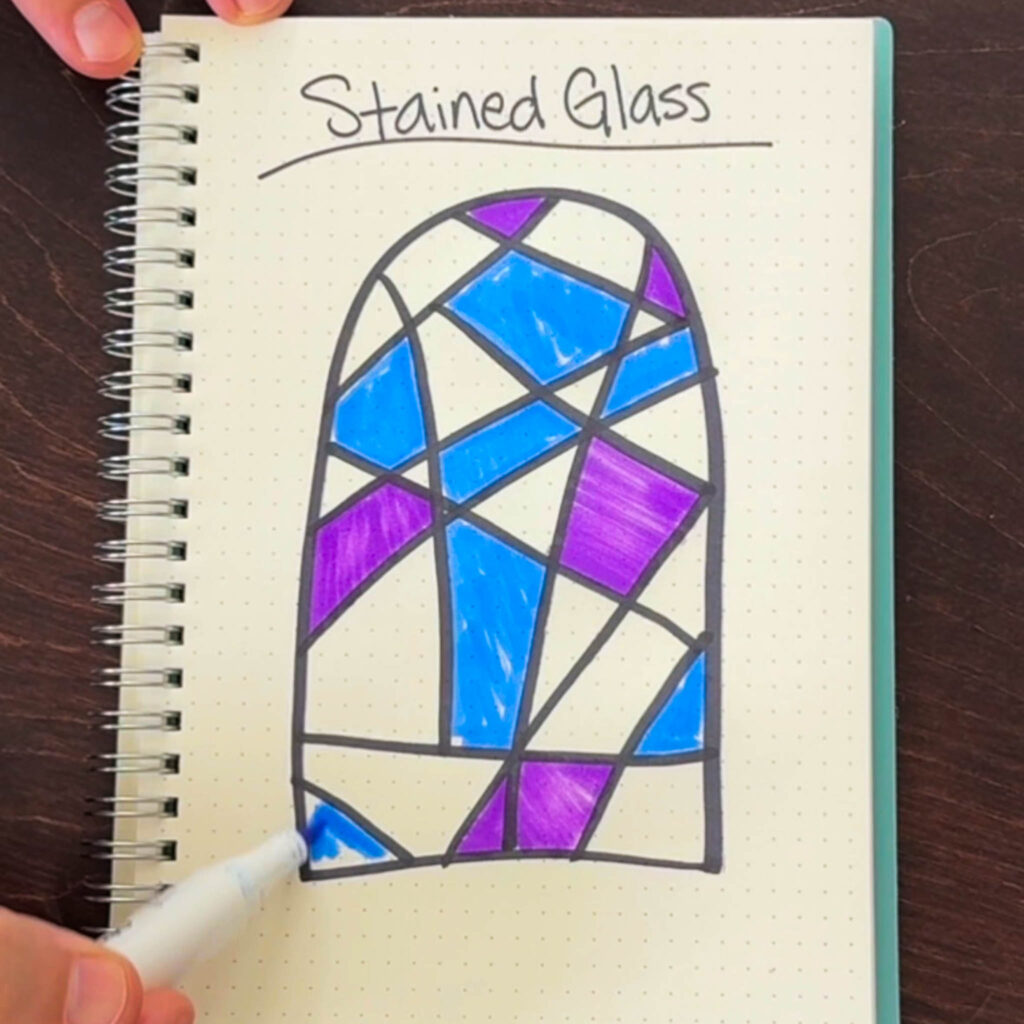
Stained Glass
2 Players
Stained Glass is a two-player area-control game played on a hand-drawn window. Start by drawing a stained-glass window shape and dividing it into many smaller pane sections with lines. Each player chooses a color. Players take turns coloring in one uncolored section. The section you choose may not share a side with any section colored by your opponent (corner-touching is allowed), but it may touch sections of your own color. The goal is to place your color in ways that block your opponent’s future options while preserving your own. Play continues until a player cannot legally color any remaining section; that player concedes, and the opponent wins.
Reverse Stained Glass
2 Players
Play the same as above, except this time players may not color in sections that would share a side with their own color. Play continues until a player cannot legally color any remaining section; that player concedes, and the opponent wins.
Crossed
2 Players
Players take turns trying to get the most points by drawing straight lines that cross previously drawn lines. To play, draw 16 dots around a square, four on each side leaving the corner locations open. Both players need their own color. Beginning with player one and alternating turns, players will select an unused dot and draw a straight line connecting it to another unused dot on one of the other three sides of the square. Dots may not be used twice. You earn 1 point for crossing your opponent’s line, and two points for crossing your own line. Keep score as you go. Continue playing until there are no more legal moves remaining. The player with the most points. wins.
Number Chain
2 Players
Number Chain is a two-player paper and pencil game played on a 6×6 grid. To set up, both players (using different colors) each start in opposite corners of the grid, placing 1 in the corner, 2 in the next diagonal square toward the center, and 3 in the square after that. On your turn, choose any one of your existing numbers and write the next number in sequence in any adjacent square (diagonals count). You can branch off any of your numbers, not just your highest, so chaining off a 3 writes a 4, but chaining off a 2 on a later turn writes a 3. As you play, try to box out your opponent so they can’t extend their chains. The game ends when the board is full, and the winner is whoever wrote the single highest number anywhere in their chains.
Prophecies
2 Players
Prophesies is a two-player game played on a 5×5 grid (though any grid size works). Players alternate turns writing a number 1 through 5 or an X in any empty space. Each number may only appear once per row and once per column. When you write a number, you’re making a prophecy — predicting that exactly that many numbers (not X’s) will end up in that row or column. Writing an X simply fills a space and can be used strategically to help or hinder prophecies without making one yourself. Play continues until every space is filled, then each row and column is counted. Any player whose prophecy matches the actual count of numbers in that row or column earns points equal to their prophecy number. The player with the most points wins.
Corners
2 Players
Players compete to fill in the most circles on a grid. Create a 7×7 grid (or a larger grid for a longer game) to begin. Using different colors, players alternate turns writing a circle into spaces on the grid. If a player ever succeeds in getting four of their color circles into the four corners of a perfect square (not a rectangle) they fill in those corner circles and then write circles into all of the open spaces that make up the square. If any of these circles create the four corners of a square, those are filled in as well. Continue alternating turns until all the spaces in the grid are filled in. The player who has the most filled in circles is the winner. If you only have one pen to play with, you can use different shapes rather than circles. A circle and a star or heart for example. Then fill in those shapes as described above.
Stickman Battle
using a notebook or two pieces of plain paper, draw 3 or more stickmen on each page in random arrangements. One paper represents your stickmen, the other is your opponent’s. Taking turns, you and a partner will add a small dot of paint or similar (I like using nail polish) to your side of your paper and then sandwich and press the paper onto your opponents. You are trying to successfully hit their stickmen with your dot, the paint will transfer to the other side and if it touches their stickman, they lose a life. Continue until someone has lost all their stickmen.